
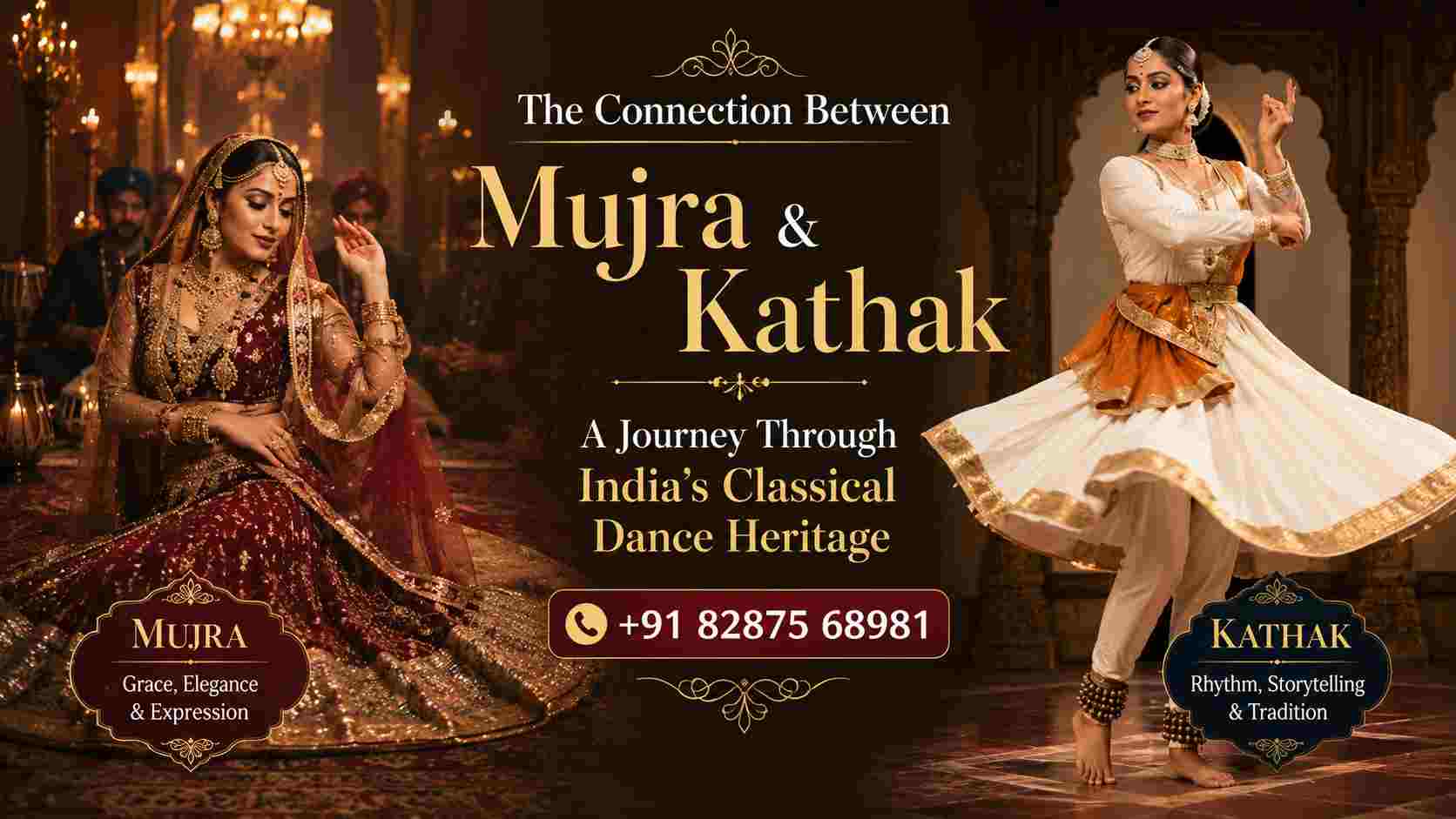
The connection between Mujra and Kathak is one of the most fascinating chapters in the history of Indian performing arts. While they are often confused as the same dance form, they have distinct identities, histories, and cultural purposes. At the same time, Mujra owes much of its grace, technical vocabulary, and expressive storytelling to Kathak. Understanding this relationship helps preserve the true heritage of both traditions while appreciating their unique evolution over centuries.
Introduction to the Relationship Between Mujra and Kathak
The connection between Mujra and Kathak has been discussed by historians, dancers, and cultural scholars for generations. Both dance traditions flourished in North India and share common roots in music, rhythm, storytelling, and expressive movement. Although Mujra developed as a refined court entertainment during the Mughal era, its dance vocabulary was deeply influenced by the classical techniques of Kathak. This historical relationship explains why many of the gestures, spins, footwork, facial expressions, and musical compositions found in Mujra resemble those of Kathak.
Today, people often mistake Mujra for Kathak or assume that they are identical. In reality, Kathak is one of India’s eight recognized classical dance forms, while Mujra is a cultural performance tradition that borrowed extensively from Kathak while developing its own distinctive identity.
Understanding Kathak Before Exploring Mujra
To understand the connection between Mujra and Kathak, it is important to first understand Kathak itself.
Kathak originated from the Sanskrit word Katha, meaning “story.” The earliest Kathak dancers were storytellers known as Kathakars who traveled from village to village narrating stories from Hindu epics such as the Ramayana, Mahabharata, and Bhagavata Purana through expressive dance and rhythmic footwork.
These performances emphasized spirituality, devotion, dramatic storytelling, and intricate rhythmic compositions. Dancers mastered complex footwork known as Tatkar, graceful spins called Chakkars, expressive facial gestures, delicate hand movements, and mathematical rhythmic patterns.
As centuries passed, Kathak gradually evolved beyond temple courtyards into royal palaces.
The Mughal Influence on Kathak
One of the strongest links between Mujra and Kathak emerged during the Mughal period.
When Mughal rulers established magnificent royal courts across North India, they became patrons of music, poetry, painting, and dance. Kathak artists found new opportunities to perform before emperors and nobles.
Instead of focusing only on religious storytelling, Kathak gradually incorporated Persian aesthetics, elegant costumes, Urdu poetry, courtly etiquette, and refined expressions of romance.
This transformation did not diminish Kathak’s classical foundation. Instead, it expanded its artistic vocabulary and prepared the environment in which Mujra would later emerge.
How Mujra Evolved from Kathak Traditions
Mujra did not appear suddenly as an entirely new dance style. Rather, it evolved from the performance traditions that already existed within royal courts.
Professional female performers known as tawaifs received extensive training in Kathak, Hindustani classical music, Urdu literature, etiquette, conversation, poetry, and fine arts.
When these accomplished artists entertained royal audiences, their performances became known as Mujra.
Although the purpose of performance shifted from religious storytelling to refined court entertainment, much of the dance technique remained rooted in Kathak.
This is why many historians describe Mujra as a cultural adaptation of Kathak rather than a completely separate invention.
Similarities Between Mujra and Kathak
The close relationship between Mujra and Kathak becomes obvious when comparing their artistic elements.
Graceful Footwork
Both dance forms rely on rhythmic footwork synchronized with tabla compositions. Dancers wear ghungroos whose sound enhances rhythmic precision.
The intricate foot movements seen during Mujra performances originate largely from Kathak training.
Elegant Spins
Kathak is famous for its smooth and perfectly balanced chakkars.
Mujra dancers also perform graceful spins, although they are generally slower and more expressive, emphasizing elegance over technical complexity.
Facial Expressions
Expression remains central to both traditions.
Whether portraying devotion, romance, longing, happiness, or sorrow, dancers communicate emotion through subtle eye movements, smiles, and facial expressions.
Hand Gestures
Both forms use graceful arm movements and hand gestures to enhance storytelling and musical interpretation.
Although Kathak includes a wider vocabulary of classical gestures, Mujra employs many similar movements in a more stylized manner.
Classical Music
Traditional Mujra performances frequently feature Hindustani classical music, ghazals, thumri, dadra, and semi-classical compositions that are also closely associated with Kathak.
Major Differences Between Mujra and Kathak
Despite their similarities, several important differences distinguish these traditions.
Purpose of Performance
Kathak primarily developed as a classical storytelling dance rooted in spiritual narratives and artistic excellence.
Mujra developed as sophisticated court entertainment emphasizing elegance, poetry, music, and refined social interaction.
Performance Setting
Kathak is now commonly performed in theaters, cultural festivals, dance academies, and international stages.
Historically, Mujra performances took place in royal courts, aristocratic gatherings, and cultural salons hosted by noble families.
Artistic Focus
Kathak emphasizes technical mastery, rhythmic improvisation, storytelling, and classical compositions.
Mujra gives greater importance to mood, elegance, romantic poetry, graceful presentation, and interaction with the audience.
The Role of Tawaifs in Preserving Kathak
One of the most overlooked aspects of Indian cultural history is the role played by tawaifs in preserving Kathak traditions.
Many highly respected tawaifs were accomplished scholars and artists.
Their education often included:
- Kathak dance
- Hindustani classical vocal music
- Urdu poetry
- Persian literature
- Etiquette
- Classical instruments
- Cultural refinement
During periods when royal patronage declined, these artists continued preserving dance, music, and poetic traditions that might otherwise have disappeared.
Several respected Kathak gharanas acknowledge the historical contribution of court dancers in maintaining artistic traditions.
Music That Connects Mujra and Kathak
Music forms another important bridge between Mujra and Kathak.
Both traditions commonly use:
- Tabla
- Sarangi
- Harmonium
- Sitar
- Santoor (occasionally)
- Classical vocals
Rhythmic cycles known as Taal guide both performances.
Popular musical forms include:
- Thumri
- Dadra
- Ghazal
- Kajri
- Hori
Many famous Kathak dancers continue performing thumri compositions that were historically associated with Mujra performances.
Costumes and Aesthetic Similarities
Visual similarities also strengthen the connection between Mujra and Kathak.
Traditional costumes often include flowing anarkalis, lehengas, churidars, embroidered dupattas, elegant jewelry, and ankle bells.
Kathak costumes today may vary depending on the school or performance theme, while Mujra costumes traditionally reflected Mughal court fashion with luxurious fabrics, intricate embroidery, and regal accessories.
Both styles emphasize graceful movement, allowing flowing garments to enhance spins and rhythmic motion.
Storytelling in Both Dance Forms
Storytelling remains a central element connecting Mujra and Kathak.
Kathak traditionally narrates mythological episodes using expressive dance.
Mujra tells emotional stories through romantic poetry, ghazals, and lyrical interpretation.
Rather than portraying religious characters, Mujra often explores themes such as love, separation, longing, beauty, admiration, and emotional depth.
Despite these thematic differences, both rely heavily on expressive acting known as abhinaya.
The Influence of Urdu Poetry
Urdu poetry significantly shaped Mujra while also influencing the evolution of Kathak during the Mughal era.
Poets composed elegant ghazals filled with symbolism, romance, philosophy, and emotional nuance.
Dancers interpreted these verses through graceful movement and expressive gestures.
This literary influence gave Mujra its distinctive sophistication while enriching Kathak’s repertoire of expressive performances.
Kathak and Mujra in Indian Cinema
Indian cinema has played a major role in popularizing both traditions.
Classic films featuring elaborate court dance sequences introduced audiences worldwide to the beauty of Mujra-inspired choreography. Many of these performances were choreographed by artists with formal Kathak training, preserving authentic footwork and graceful movements even in cinematic adaptations.
As a result, film audiences often associate the elegance of Kathak with the visual style of traditional Mujra.
Common Misconceptions About Mujra and Kathak
A widespread misconception is that Mujra and Kathak are exactly the same dance.
This is incorrect.
Kathak is an internationally recognized classical dance tradition with centuries of formal pedagogy, while Mujra is a historical performance tradition influenced by Kathak, Hindustani music, Mughal aesthetics, and Urdu literary culture.
Another misconception is that Mujra lacks artistic value. Historically, many Mujra performers were exceptionally trained artists who contributed significantly to India’s musical and dance heritage.
The Cultural Legacy of Mujra and Kathak
Today, Kathak continues to thrive through academies, universities, cultural festivals, and professional performances across the world.
Traditional Mujra, meanwhile, is increasingly studied as part of India’s cultural and performing arts history. Scholars recognize its contribution to preserving classical music, poetic traditions, etiquette, costume design, and dance aesthetics.
Understanding their historical relationship allows audiences to appreciate how artistic traditions evolve while retaining elements of their origins.
Why Understanding Their Connection Matters
Learning about the connection between Mujra and Kathak encourages a more informed appreciation of India’s diverse cultural heritage. Rather than viewing them as unrelated or interchangeable, recognizing their shared history highlights how classical techniques can adapt to new social and artistic environments.
Kathak provided the technical and expressive foundation, while Mughal court culture shaped the refined presentation that became associated with Mujra. Together, they reflect centuries of artistic exchange involving dance, music, literature, fashion, and performance.
Conclusion
The connection between Mujra and Kathak is rooted in history, artistic evolution, and cultural exchange. Kathak, with its origins in storytelling and classical dance, laid the technical groundwork for many of the movements, rhythms, and expressive elements later seen in Mujra. Under the patronage of Mughal courts, these traditions intersected, giving rise to a sophisticated performance culture that blended classical dance, Hindustani music, Urdu poetry, and courtly elegance.
Although Kathak and Mujra have different identities and purposes, they remain historically intertwined. Kathak continues to flourish as one of India’s great classical dance forms, while Mujra stands as an important part of the cultural history of North India, reflecting the artistic refinement of royal courts and the enduring influence of Kathak on India’s performing arts.